Legal Authorization to Operate
FSSAI License legally authorizes your food business to operate as per the Food Safety and Standards Act, 2006 and protects you from unwanted legal action.
 Connect with our experts
FSSAI News Update: Food Businesses Can Now Be Fined Rs. 5 Lakh & 6 Months Jail for Not Having Food License. FoSCos registration or license is required for all entities involved in the manufacture, distribution and transportation of food products. ✔Support all states ✔3 Types of License: Local, State & Central ✔Application in Same (Priority) ✔10yrs Experienced FoSCos Expert ✔Lowest Fees than Other Portals




Fill in the form below and our FoSCoS experts will assist you end-to-end.

For Businessess having Turnover < ₹12 Lakh
 * Eligibility check* Document verification* Application drafting* Filing on FSSAI portal* Follow-up for approval* Certificate download
For Businessess having Turnover ₹12 Lakh – ₹20 Crore
* Eligibility & category check* Document verification* Application drafting* Filing of State License application* Follow-up with Food Department* Final license downloadFor Businessess having Turnover > ₹20 Crore / E-commerce / Import/Export
* Eligibility check* Document & premises verification* Central License application drafting* Filing on FSSAI portal* Department coordination* Final license download

| License Type | Eligibility | Validity |
|---|---|---|
FSSAI FoSCos Basic License |
Annual turnover of the business is less than 12 lakhs |
1 To 5 Years |
FSSAI FoSCos State License |
Annual turnover of the business is between 12 lakhs to 20 crores |
1 To 5 Years |
FSSAI FoSCos Central License |
Annual turnover of the business is above 20 crores |
1 To 5 Years |
FSSAI launched Food Safety Compliance System (FoSCoS) w.e.f. 1st June 2020 replacing the existing Food Licensing and Registration System. Food License Registration certificate is required to run a food product business. You have to register under Food Safety and Standards Authority of India (FSSAI) to manufacture, distribute and transport food products. FSSAI is established under the Ministry of Health & Family Welfare, Government of India, under the Food Safety and Standards Act, 2006. FSSAI Certificate and FSSAI License are the same and ensure that the food being sold is safe, hygienic and compliant with national standards.
There is no difference between FSSAI, FoSCoS and Food License. These terms are commonly used for the same FSSAI Registration / License issued by the Food Safety and Standards Authority of India.
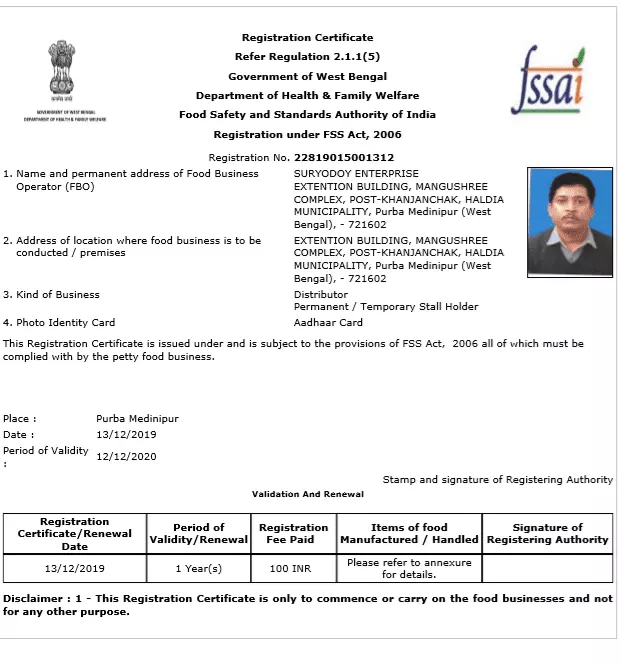
FSSAI License legally authorizes your food business to operate as per the Food Safety and Standards Act, 2006 and protects you from unwanted legal action.
Displaying the FSSAI logo and license number assures customers that your food is safe, hygienic and compliant with national standards, boosting brand trust.
FSSAI registration is often mandatory for tie-ups with supermarkets, online platforms, distributors and for expanding to multiple locations or states.
It enforces proper hygiene, storage, processing and labeling practices, reducing the risk of contamination and food-borne illnesses.
Banks, investors and financial institutions prefer dealing with FSSAI compliant businesses, improving your chances of getting loans and investment.
Using the FSSAI logo on your packaging, menu and marketing creatives highlights quality and gives you an edge over unregistered competitors.
Proper FSSAI registration and compliance protect your business from heavy fines, product seizure, or closure for non-compliance with food safety laws.
Systematic compliance with FSSAI norms ensures smooth operations, fewer legal hassles and long-term, sustainable growth of your food business.
FSSAI License is essential to supply to modern trade, export, institutional buyers, hotels, airlines and large retail chains.



Running a food business without FSSAI registration or license is illegal. Authorities can impose fines up to ₹5,00,000 and even order closure of the business.
Supplying unsafe, contaminated or adulterated food can attract imprisonment from 6 months to 7 years along with heavy monetary penalties and license cancellation.
Wrong ingredient list, fake claims, incorrect expiry date or misleading information on packaging can result in fines up to ₹3,00,000 and suspension of license.
Not displaying the FSSAI registration number on premises, menu or product labels is a violation and may lead to warnings, fines and closer monitoring.
Poor hygiene, unsafe storage or handling of food can result in monetary penalties, product seizure and in extreme cases, shutdown of operations.
Not cooperating with FSSAI officials during inspections or delaying them is considered an offence and may lead to fines and stricter audits.
Failure to renew FSSAI License before expiry attracts late fees and can result in suspension or cancellation of the license, stopping your food operations.
All essential documents needed for hassle-free FSSAI registration.
PAN Card / Aadhaar Card / Passport / Voter ID of the proprietor, partner or director.
Recent passport-size photograph for KYC and records.
Electricity bill, property tax receipt, sale deed or rent agreement along with latest utility bill.
Proprietorship: GST certificate (if available) or declaration; Partnership: Partnership Deed; Company / LLP: Incorporation Certificate, MOA & AOA / LLP Agreement.
Complete list of food items that will be manufactured, stored, distributed, catered or sold.
Floor plan of kitchen / manufacturing unit showing storage, processing area, washing area, entry and exit.
Fire NOC, Pollution control consent, FSSAI of raw material suppliers, etc., wherever required.
Declaration regarding compliance with FSSAI regulations, hygiene standards and authenticity of information.
Mandatory if the premises are rented or on shared property.
For manufacturers: list of machinery and production capacity; for restaurants/cloud kitchens: seating capacity, kitchen details, waste disposal system; for health foods/supplements: product specs or lab reports.











Your FSSAI License journey broken down into clear, simple steps.
Determine whether you need Basic Registration, State License or Central License as per turnover & business scale.
Collect all required documents like ID proof, address proof, premises proof, product list and NOCs (if applicable).
Create login on the FoSCoS (FSSAI) portal and choose the correct application (Form A or Form B).
Fill the application form with accurate business details, operational address and list of food products.
Upload all scanned documents and pay the applicable government fees for the chosen validity (1–5 years).
Submit the application and note the Application Reference Number (ARN) for tracking.
Respond to any queries or inspection requirements raised by the FSSAI officer.
Receive your FSSAI License certificate and prominently display the license number at premises and on packaging.