 Connect with our experts
GST Registration with the Experts of Invenix India – Fast, Simple & Fully Online
GST Registration is mandatory for businesses supplying goods with annual turnover above ₹40 lakh and service providers with turnover above ₹20 lakh (₹10 lakh in special category states). It is also compulsory for inter-state suppliers, e-commerce sellers, importers, exporters, and businesses seeking Input Tax Credit (ITC).
Registered businesses receive a unique GSTIN, enabling legal tax collection and ITC claims on purchases. GST registration enhances business credibility and ensures compliance with government regulations. Non-registration may lead to penalties and restrictions on operations. Invenix India Financial Technologies Pvt Ltd provides seamless GST registration with quick processing, documentation support and complete compliance assistance.




Need Help with GST Registration?
Fill up the form below and our GST experts will call you.

Types of GST Registration
GST registration is mandatory for businesses to legally collect and pay GST. Different categories like Regular, Composition, Casual Taxable Person, Non-Resident Taxable Person, and E-Commerce Operators are designed for specific business needs. Invenix provides seamless assistance for all types of GST registrations.
Regular GST Registration
Applicable for businesses whose annual turnover exceeds the prescribed threshold. It allows the taxpayer to collect GST from customers and claim full Input Tax Credit on purchases, making it the most common business category under GST.
Composition Scheme Registration
Designed for small businesses with limited turnover. It offers lower tax rates and simplified compliance, but taxpayers under this scheme cannot issue tax invoices or claim Input Tax Credit.
Casual Taxable Person
Required for businesses that operate temporarily or occasionally in a different state (exhibitions, trade fairs, seasonal events). Registration is valid for a limited period and requires advance GST payment.
Non-Resident Taxable Person
Mandatory for foreign individuals or companies supplying goods or services in India without a fixed place of business. It ensures tax compliance for cross-border suppliers operating temporarily in India.
E-Commerce Operator (ECO)
Mandatory for digital platforms that facilitate supply of goods or services between sellers and buyers, regardless of turnover. Includes marketplaces, ordering apps, delivery aggregators and service aggregators.
TCS & TDS GST Registration
TCS registration is compulsory for e-commerce operators who collect tax on net taxable supplies. TDS registration applies to specified government departments and notified bodies responsible for deducting tax while making payments.
Documents Required for GST Registration
All essential documents needed for seamless GST registration and compliance.
PAN Card of the business or proprietor
Aadhaar Card or valid identity proof of owner/directors
Passport-sized photographs of owner(s) or directors
Proof of business address – Rent agreement, electricity bill or ownership documents
Bank account details with cancelled cheque
Proof of Business – Partnership Deed or Incorporation Certificate
MOA & AOA (for companies)
Board Resolution / Authorization letter for authorised signatory (for companies)
What is a GST Return?
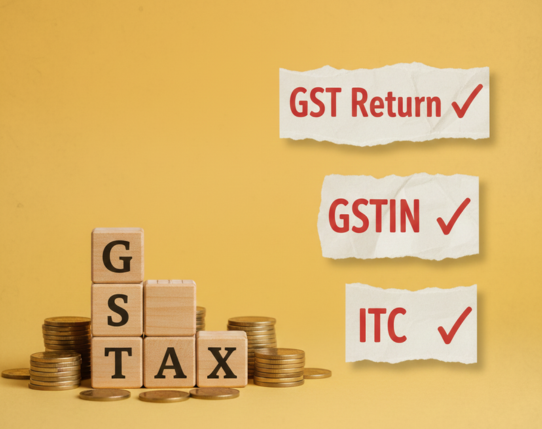
A GST Return is a statement filed online by registered taxpayers containing details of their sales, purchases, tax collected and tax paid. It enables the government to track indirect tax collection and ensures transparency in business transactions. Filing GST returns is mandatory even if there are no transactions in a period. Timely filing allows businesses to claim ITC, maintain compliance and avoid penalties. Invenix provides complete GST return filing support and compliance management.
What is GSTIN?
GSTIN (Goods and Services Tax Identification Number) is a unique 15-digit ID issued to every business registered under GST. It is used on invoices, returns, e-way bills and all official documents to identify taxpayers and track tax compliance. It enables legal tax collection, smooth ITC claims and transparent operations. Invenix offers reliable GST registration and GSTIN assistance end-to-end.
What is ITC?
ITC (Input Tax Credit) is the credit of GST paid on purchases which can be used to reduce GST payable on sales. Businesses can adjust the tax already paid on inputs and pay only the balance to the government. ITC can be claimed only when the supplier files returns and pays tax, and the buyer has a valid invoice and has received goods/services. ITC is restricted for personal expenses and certain items like food, club membership and vehicles for personal use. It must be claimed within the prescribed time limit (up to 30th November of next financial year or before filing annual return, whichever is earlier).




Benefits of GST Registration

Legal Recognition for Business
GST registration formally recognises your business across India, enabling you to issue tax invoices and comply with GST law, building trust with customers and vendors.
Input Tax Credit Eligibility
Registered businesses can claim credit for taxes paid on purchases and services, reducing overall tax liability and avoiding cascading tax.
Pan-India & Online Expansion
GST is mandatory for inter-state and e-commerce supplies. Registration lets you sell across India and on online marketplaces without restrictions.
Higher Business Credibility
Corporates, distributors and large buyers prefer GST-compliant vendors. A valid GSTIN boosts your professional image and compliance reliability.
Access to Tenders & Contracts
Government tenders and big contracts generally require a GSTIN. Registration opens doors to larger projects and higher revenue opportunities.
Who Should Register for GST?
GST Registration Packages – Professional Fees
Basic GST Registration
(within 10–15 Days)
₹ 1,499.00
 Collection and verification of required documents
- Preparation and filing of GST REG-01 application
- Assistance with Aadhaar OTP authentication
- Tracking of application status until GSTIN is issued
Express GST Registration
(within 2 hrs)
₹ 3,499.00
- Priority and same-day document verification
- GST application filing within 2–3 hours
- Support for Aadhaar e-KYC for auto-approval
- Assistance in selecting correct HSN/SAC codes
- Guidance on GST-compliant invoice format.
- Support in opting for Composition Scheme
- Complete GST portal profile setup
Premium Plan
GST Registration + Complete Setup (1–2 Days)
₹ 13,993.00
- Priority and same-day document verification
- GST application filing within 2–3 hours.
- Support for Aadhaar e-KYC for auto-approval
- Assistance in selecting correct HSN/SAC codes
- Complete GST portal profile setup
- Addition of bank details, business locations, and signatories
- Evaluation of e-invoice and e-way bill applicability
- Assistance in creating first GST-compliant invoice
- 30-day post-registration compliance support
- Filing of GSTR-1 and GSTR-3B for 6 months


GST Registration – Step-by-Step Process
Your GST registration journey broken down into clear, simple steps.
Collect basic business and applicant details.
Generate TRN (Temporary Reference Number) on GST portal.
Fill Part A and Part B of GST registration application.
Upload all required documents and place of business proof.
Complete Aadhaar authentication for faster approval.
Submit the application with DSC / EVC as applicable.
Jurisdictional officer verifies your application and documents.
Reply to any clarification or query raised by the officer.
Receive GSTIN approval and download GST registration certificate.